- Historical
- 2026-05-06
Standing as the world’s oldest and largest monolithic statue, the Great Sphinx of Giza is more than just a monument it is an eternal symbol of Egypt’s power, mystery, and architectural genius. Carved directly from a single outcrop of natural limestone bedrock on the Giza Plateau, this colossal figure features the body of a lion and the head of a human, believed to be the Pharaoh Khafre.
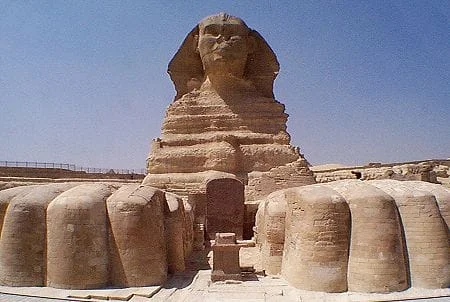
The Great Sphinx of Giza
The Sphinx is a masterpiece of monumental sculpture, striking a naturalistic contrast to the geometric perfection of the nearby pyramids.
It faces directly East, toward the rising sun, symbolizing the perfect fusion of solar divinity and pharaonic strength.
• Total Length: Approximately 73 meters (240 feet).
• Total Height: Approximately 20 meters (66 feet) from the base to the top of the head.
• Total Width: Roughly 19 meters (62 feet) at the rear haunches.
• Weight of the Head: Estimated at 200 tons.
Who Built the Sphinx?
While the Sphinx remains one of archaeology's most debated subjects, most Egyptologists agree on its origins.
The Old Kingdom Consensus
Scholars generally attribute the Sphinx to Pharaoh Khafre (Fourth Dynasty) around 2570–2500 BCE. It is strategically positioned within Khafre's pyramid complex, connected to his Valley Temple and mortuary structures.
• Craftsmanship: It is believed that over 100 skilled workers carved the Sphinx using copper chisels and stone hammers, completing the massive task in roughly three years.
• Material Removal: To reveal its shape, workers removed approximately 200,000 tons of limestone, much of which was reused to build the nearby Sphinx Temple.
Research indicates the Sphinx was once a colorful masterpiece. Traces of red, blue, and yellow pigments have been found, suggesting a red face and a vivid blue-and-gold royal headdress (nemes).
The Missing Nose
Contrary to the popular legend that Napoleon’s troops used the nose for target practice, historical drawings from before Napoleon’s arrival show the nose was already missing. Some accounts attribute the damage to a Sufi Muslim named Muhammad Sa'im al-Dahr in 1378, who reportedly defaced it in an act of iconoclasm.
The Hidden Chambers
For centuries, legends have spoken of secret rooms beneath the monument, including the legendary "Hall of Records". While modern seismic surveys and ground-penetrating radar have detected anomalies and cavities—such as a rectangular chamber 25 feet below the front paws—no confirmed ancient archive has ever been found.
Water Weathering Theory
Alternative theories, proposed by researchers like Dr. Robert Schoch, suggest the Sphinx could be as old as 7,000 to 9,000 years. This theory is based on vertical, undulating weathering patterns on the body, which Schoch argues were caused by heavy rainfall—a climate Egypt has not experienced for thousands of years prior to the Old Kingdom. However, most mainstream Egyptologists reject this, citing stylistic and archaeological evidence linking it to Khafre.
Ready to answer the call of the Pharaohs? Visit us at www.redrosetours.com to book your Egypt memorable trip.