- Historical
- 2026-05-06
you want to experience the true evolution of pyramid building without the heavy crowds of Giza, Dahshur is your destination. Located about 40 kilometers south of Cairo, this royal necropolis served as a crucial testing ground for the pharaohs of the Old Kingdom.
The Vision of Sneferu
Dahshur is the legacy of Pharaoh Sneferu (father of Khufu), who was the most prolific builder in Egyptian history. After experimenting at Meidum, Sneferu moved his royal cemetery to Dahshur to perfect the transition from "step" pyramids to "true" smooth-sided pyramids.
The Bent Pyramid: A Unique Architectural Transition
The Bent Pyramid is one of the most striking structures in Egypt. It is famous for its unique silhouette, which changes its angle of inclination halfway up.
The Angle Shift
Construction began at a steep 54-degree angle. When the structure began to show signs of instability, the builders frantically shifted to a safer 43-degree angle to complete it.
Unlike the pyramids at Giza, the Bent Pyramid still retains a vast majority of its original polished limestone casing, giving you a vivid look at how these monuments appeared 4,500 years ago.
The Interior Recently opened to the public, the interior involves a narrow, 79-meter tunnel that leads to a magnificent corbelled burial chamber.
The Red Pyramid: The First True Pyramid
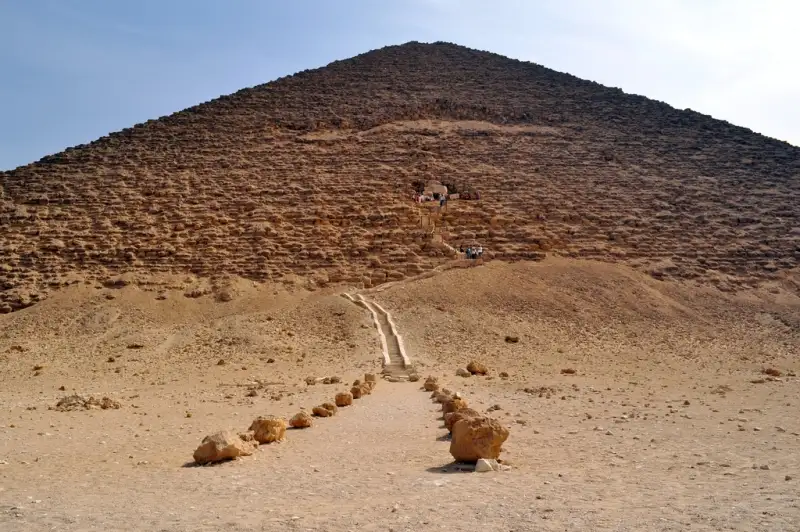
Learning from the "mistake" of the Bent Pyramid, Sneferu successfully built the Red Pyramid right next to it.
This was the world's first successful smooth-sided "true" pyramid.
• Why "Red"?: It earned its name from the reddish hue of the local limestone blocks used for its core, which became visible after its white limestone casing was stripped away centuries ago.
The Red Pyramid is often much quieter than Giza. You can climb down into its three high-ceilinged chambers and stand in the very spot where the foundations for the Great Pyramid of Khufu were conceptually born.
The Black Pyramid of Amenemhat III
Further in the distance, you will see the crumbling remains of the Black Pyramid, built during the Middle Kingdom. Unlike the stone giants of Sneferu, this was made of mudbrick. Over time, the core has eroded, leaving behind a dark, jagged mound that looks like a natural mountain rising from the desert floor.
Ready to answer the call of the Pharaohs? Visit us at www.redrosetours.com to book your Egypt memorable trip.