- Historical
- 2026-05-07
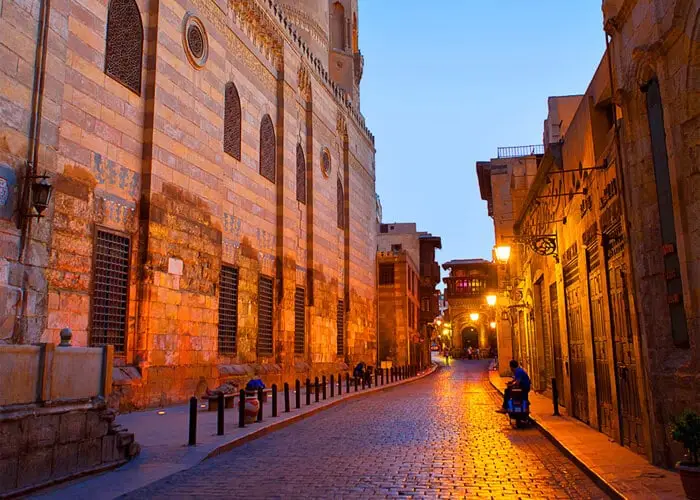
Explore 1,000 years of history in one street. Visit Al-Muizz Street and Khan el-Khalili. Experience Cairo’s iconic bazaar, historic mosques, and the famous El Fishawy cafe.
Exploring the Soul of Cairo The Hidden Gems of Old and Islamic Cairo
Al-Muizz Street
The "Palace of the World"Often called the "world's largest open-air museum of Islamic monuments," this 1-km street was the spinal cord of the Fatimid city of Al-Qahira (Cairo), founded in 969 CE.The Fatimid Foundation.
The street is named after Al-Mu'izz li-Din Allah, the fourth Fatimid Caliph. In the 10th century, this wasn't a market it was a restricted royal precinct. Only the Caliph, his family, and his high officials were allowed to walk here.
Originally, the street sat between two massive palaces (the Eastern and Western Palaces).
These palaces were so large they could house 12,000 people.
Today, those palaces are gone, but their footprints are occupied by the famous Qalawun Complex and other monuments.
The Mamluk Golden Age When the Mamluks took over (1250–1517 CE), they transformed the street from a private royal road into a public center of learning and charity.
Every Sultan wanted to outdo his predecessor. This resulted in the Complex of Sultan Qalawun, which included a mosque, a madrasa, and a Bimaristan (hospital) The Qalawun hospital was revolutionary; it treated all citizens for free, regardless of status, and used music therapy and flowing water to soothe patients—all in the year 1284!2. Khan el-Khalili: From Royal Tomb to Global BazaarWhile Al-Muizz was about power, the Khan was about profit. It has been the commercial heart of the Middle East for over 600 years.The Dark Origins (The Saffron Tomb) Before it was a market, the site of the Khan was a burial ground for the Fatimid Caliphs, known as Turbat al-Za'faran (The Saffron Tomb).In 1382 CE, an enterprising Mamluk Prince named Jaharkas el-Khalili cleared the site (moving the remains to a nearby hill) to build a Khan was essentially a medieval hotel for merchants.
Ground Floor: Stables for camels and warehouses for expensive goods (spices, silks, gold).
Upper Floors: Living quarters for traveling traders from as far as China, India, and Venice.
Because Prince el-Khalili provided security for these merchants, the market became the most trusted place to trade luxury goods in the Mediterranean. The Ottoman Transformation In the 16th century, under Ottoman rule, the Khan was rebuilt into the labyrinth we see today.
It became the global center for coffee trading and spice monopolies.
El Fishawy Cafe: Established in 1773, this cafe has been open 24/7 for over 250 years. It was the "office" for Nobel Prize-winning author Naguib Mahfouz and countless revolutionary thinkers.
Bab al-Futuh Fatimid (1087)The Gate of Conquests. One of the few surviving stone gates of the original walled city.
Sabil-Kuttab Ottoman (1744)A stunning "water fountain and school. It shows how elite citizens provided free water and education to the poor.
Bayt al-Suhaymi Ottoman (1648)The finest example of a private Islamic mansion, showing how people stayed cool in the Cairo heat using Mashrabiya windows.
Ready to answer the call of the Pharaohs? Visit us at www.redrosetours.com to book your Egypt memorable trip.